Peace Garden State, Prairie Connection: How to Get a Free Government Cell Phone in North Dakota (2026)
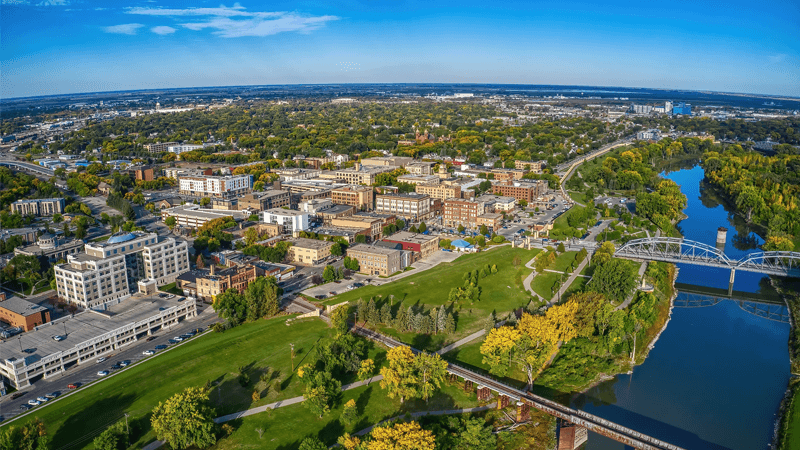
North Dakota runs a no-frills version of the federal Lifeline program. There's no state cash bonus on top of the federal $9.25 — what you see is what you get. But ND is one of the lowest-population-density states in the country: prairie, badlands, and oil-boom towns scattered across a huge footprint. So the practical question isn't "how much is the discount?" It's "which provider's tower will actually reach my house?" This guide walks you through eligibility, the provider-by-region choice that matters most here, and how to apply without getting caught by ND's most common rejection trap (rural addresses).
What Is Lifeline?
Lifeline is a federal program that takes $9.25 off your monthly phone or internet bill if you qualify. Most providers price their basic plan at exactly that amount, so you usually pay $0. The program is overseen by the FCC and run day-to-day by the Universal Service Administrative Company (USAC).
What you get:
- A free smartphone (or a free SIM card to use a phone you already own)
- Unlimited talk and text
- A monthly bucket of high-speed data
- No contract, no credit check, no activation fee
Do You Qualify?
You qualify for Lifeline in North Dakota if you meet one of these:
1. You're enrolled in a qualifying government program, including:
- North Dakota Medicaid
- SNAP
- Supplemental Security Income (SSI)
- Federal Public Housing Assistance (Section 8)
- Veterans Pension or Survivors Benefit
- Tribal programs (BIA General Assistance, Tribal TANF, FDPIR)
2. Your household income is at 135% of the Federal Poverty Guidelines or under — roughly $21,500 a year for a single person, about $44,500 for a family of four.
Only one Lifeline benefit per household. If a roommate or family member at your address already has Lifeline, you can still qualify — fill out a Household Worksheet showing you operate as a separate financial unit.
Good news for ND Medicaid and SNAP recipients: the state's health-and-social-services agency maintains a direct data feed into the National Verifier. If you're already on either program, your Lifeline application typically auto-approves in seconds, no document upload required.
Choosing a Provider in North Dakota
This is the single most important decision you'll make. North Dakota's coverage map splits into three rough zones, and the wrong network choice means your "free" phone will sit useless on your kitchen counter.
| Provider | Network | Monthly High-Speed Data | Free Phone? | Best For |
|---|---|---|---|---|
| SafeLink Wireless | Verizon | Up to 10 GB | Free basic Android or BYOP | Most rural ND counties |
| Assurance Wireless | T-Mobile | 10 – 12 GB | Free 5G smartphone | Fargo, Bismarck, Grand Forks, I-29/I-94 |
| Life Wireless | AT&T | 4.5 GB (10 GB Tribal) | Free basic phone | Bakken oil region |
| TruConnect | T-Mobile | 4.5 – 10 GB | Free phone or BYOP | International callers in metros |
| AirTalk Wireless | T-Mobile | 5 – 10 GB | Free 5G smartphone | Urban users wanting better hardware |
| StandUp Wireless | T-Mobile | 4.5 GB | Free smartphone | Standard urban use |
Which One Should You Pick?
Fargo, Bismarck, Grand Forks, or anywhere along I-29 or I-94 — go with a T-Mobile-based plan. Assurance Wireless is the most widely used and ships a free 5G phone. T-Mobile's mid-band 5G is well-deployed in the main population corridors.
The Bakken oil region — Williston, Watford City, Killdeer, Tioga, and the surrounding oil-patch counties — look at Life Wireless on AT&T. This is an unusual recommendation for a rural region, but AT&T built out FirstNet (the federal first-responder network) aggressively during the 2010s oil boom. The result: AT&T coverage in the Bakken is significantly stronger than in similar rural areas elsewhere in the country.
Everywhere else rural — Turtle Mountains, the Missouri Coteau, badlands counties like Slope and Bowman, the Red River Valley off I-29 — pick SafeLink Wireless. It runs on Verizon, whose 700 MHz low-band signal travels much further across open prairie than T-Mobile's mid-band 5G. SafeLink's data cap is smaller on paper, but that doesn't matter if there's no signal.
On Tribal lands — verify coverage with your tribal social services office before signing up. Some districts of larger reservations like Fort Berthold can have spotty service even on Verizon.
Bring Your Own Phone (BYOP): Free Lifeline phones are entry-level Androids. If you already own a smartphone you like, ask your provider for a SIM-only kit instead. Your daily experience will be much better — and ND's harsh winter conditions are tough on cheap hardware, so a more durable existing phone is genuinely an advantage.
How to Apply
The application runs through the federal National Verifier. It takes about 10–15 minutes if your documents are ready.
Step 1: Gather your info. Full legal name (exactly as on your Social Security card), date of birth, last four digits of your SSN, your North Dakota physical address (a farm route is fine, but have a utility bill on hand — see below), and proof of your qualifying program or income.
Step 2: Apply at CheckLifeline.org. The verifier instantly checks ND Medicaid and SNAP via ND HHS, plus federal records for SSI, FPHA, and Veterans Pension. A match means you're approved immediately.
Step 3: Upload documents if asked. Income-qualified applicants need three consecutive months of pay stubs, last year's tax return, or W-2 forms. Pay stubs older than ~3 months are rejected.
Step 4: Pick a provider. Take your Application ID to your chosen carrier. They'll ship a SIM or phone within a few business days.
Step 5: Use your phone within 30 days. Make a call, send a text, or use data off Wi-Fi. ND winters can produce extended power outages — if you can't charge your phone for several days during a blizzard, get a usage event in as soon as power comes back. The 30-day clock doesn't pause for weather.
Common Problems and How to Fix Them
- "Address not found": This is the single most common rejection in North Dakota. Farm route numbers, township-and-range identifiers, and addresses without standard street numbers don't match the USPS database. The fix: open the verifier's map tool, drop a pin on your house, and add one piece of supplemental proof — a utility bill, a residency letter from a landlord, or a recent tax document works. Plan for this on your first application, not after a rejection.
- "Identity not verified": Almost always a name mismatch with Social Security records. Use your full legal name exactly as on your card — no nicknames, no shortened versions.
- "Duplicate household": Someone at your address already has Lifeline. Submit the Household Worksheet showing you don't share income and expenses with that person.
- Stuck in manual review for over two weeks: Call USAC at 1-800-234-9473 to check your application status.
Lifeline on Tribal Lands in North Dakota
North Dakota is home to five federally recognized resident tribes. If your address is on qualifying Tribal land, your benefit jumps to the Enhanced Tribal Lifeline rate of up to $34.25 per month, plus a one-time Tribal Link-Up credit worth as much as $100 toward starting service.
| Tribe / Reservation | County / Counties | Notes |
|---|---|---|
| Standing Rock Sioux | Sioux County (and Corson, SD) | Crosses into South Dakota |
| Spirit Lake Tribe | Benson + 3 surrounding counties | Devils Lake region |
| Three Affiliated Tribes / MHA Nation (Fort Berthold) | Six counties spanning the Bakken | Mandan / Hidatsa / Arikara |
| Turtle Mountain Band of Chippewa | Rolette | Near the Canadian border |
| Sisseton-Wahpeton Oyate | Small ND portions of Richland / Sargent | Mostly in SD |
To claim the enhanced rate, you'll need a Tribal ID card, a Certificate of Degree of Indian Blood, or documentation of participation in a Tribal program (FDPIR, Tribal TANF, BIA General Assistance). The smoothest path: apply through the social-services office of your tribe — they'll attach the right documents and ensure the $34.25 rate gets applied correctly.
Special Situations
Seniors
Most ND seniors qualify through SSI or Medicaid. If you've never moved to a smartphone — common in rural ND and on some Tribal lands — note that voice-only Lifeline (the $5.25 monthly version) remains available. The FCC paused its scheduled phase-out in mid-2025, and the program is funded through at least the end of this year. For county-level help with paperwork, your local social services office can help you gather your Social Security benefit statement and other documents.
Foster Youth
Youth aging out of North Dakota foster care typically qualify through Medicaid. You'll need a county DSS verification letter or a court-issued "Ward of the State" document to upload to the verifier. Your county Children and Family Services caseworker can produce this on request.
Veterans
A Veterans Pension or Survivors Benefit auto-qualifies you — the verifier confirms with the VA in seconds. For rural ND veterans, SafeLink on Verizon is again the most reliable network choice. Bakken-region veterans should look at Life Wireless on AT&T's FirstNet.
Your Rights as a North Dakota Lifeline User
ND's consumer protections come from three sources: the Public Service Commission (wireline carriers), the Attorney General's office (deceptive practices under N.D.C.C. §51-15), and federal Lifeline rules covering everyone.
- No early termination fees — switch providers any time (limited to once every 60 days under federal rules).
- Free 911 access even if your service is suspended for non-payment or non-use.
- Number portability — keep your 701 number when you change carriers.
- Anti-slamming protection — your provider can't be switched without your permission. Violations go to the ND Attorney General at 1-800-472-2600.
- Truthful marketing — under N.D.C.C. §51-15, "free phone" advertising that hides ongoing fees, misrepresents data caps, or buries throttling terms is actionable. The AG's Consumer Protection and Antitrust Division handles complaints.
- Wireline disconnect notice and dispute rules — administered by the ND Public Service Commission at 1-877-245-6685.
Deceptive marketing tactics — particularly door-to-door enrollment scams that have shown up in the Bakken communities — should be reported to the AG immediately.
Frequently Asked Questions
Does ND add a state credit on top of the $9.25? No. North Dakota runs a strictly federal Lifeline program. The monthly amount applied to your bill is the federal credit alone — $9.25 for broadband/bundled or $5.25 on voice-only plans.
Why does my rural ND address keep getting rejected? USPS doesn't recognize many farm and rural-route addresses in the state. The fix: drop a pin on the verifier's map and add a utility bill, lease, or tax document as supplemental proof.
Just moved to Williston for oil work — which provider should I use? Life Wireless on AT&T is the strong recommendation. The FirstNet rollout during the oil boom made AT&T's Bakken coverage notably better than other rural areas.
Can I keep my plan if I move between ND and SD? Yes. National MVNOs cover both Dakotas on the same plan. Just update your address with the provider and the National Verifier within 30 days. Standing Rock and Sisseton-Wahpeton members who cross the state line keep the benefit.
My Tribal address doesn't have a street number — what do I do? Same fix as other rural cases: drop a pin on the map and attach supplemental proof. Your tribal social services office can typically supply a residency letter.
Is voice-only Lifeline still available? Yes. The FCC paused its planned phase-out mid-2025, and the $5.25 voice-only version is funded through at least the end of 2026.
Coverage isn't great — how do I switch providers? Federal rules let you transfer between Lifeline carriers once every 60 days. Give the new carrier your Application ID — they handle the rest through the verifier.
Bottom Line
North Dakota's Lifeline program is straightforward: federal $9.25, no state add-on, but a real benefit nonetheless. The hard part isn't qualifying — if you're on ND Medicaid or SNAP, you're auto-approved — it's picking the right provider for your part of the state. Lean toward T-Mobile-based plans in the I-94/I-29 metros, AT&T-based Life Wireless in the Bakken, and SafeLink on Verizon everywhere else.
Start your application at CheckLifeline.org. If your rural address gets rejected, have a utility bill ready before you try again. If you're on any of ND's five federally recognized Tribal lands — Standing Rock, Spirit Lake, Fort Berthold (MHA Nation), Turtle Mountain, plus the small Sisseton-Wahpeton holdings — apply through your tribe's social services office. If you get stuck, USAC's support line is 1-800-234-9473 and the ND PSC consumer line is 1-877-245-6685.
Related Articles
Badger State, Bigger Benefit: How to Get a Free Government Cell Phone in Wisconsin (2026)
Wisconsin stacks a state Universal Service Fund supplement on top of federal Lifeline, so a qualifying household can get up to $18.50 a month — one of the biggest combined benefits in the country. Here's how to claim it, why you must ask each carrier if they're 'federal-only,' and the Wisconsin-specific debt rule that can block your enrollment.
July 11, 2026Mountain State, Mailed Method: How to Get a Free Government Cell Phone in West Virginia (2026)
West Virginia runs two low-income phone programs side by side: standard federal wireless Lifeline plus a state Tel-Assistance program that caps qualifying wireline service at $7.50 for anyone 60+ or disabled. Here's how each track works, what the Green Bank Quiet Zone means for wireless plans, and how to file the paper-only ES-TA-2 form with your local DHS office.
July 4, 2026